How to Scale Fitness Training Businesses in 2026

Imagine transforming your fitness training business from a solo operation into a scalable powerhouse that thrives amid 2026's digital revolution. With the wellness industry exploding, driven by AI personalization and hybrid training models, savvy entrepreneurs are multiplying their impact and revenue streams. Yet, many intermediate trainers hit plateaus, juggling client demands while dreaming of expansion.
This guide equips you with proven strategies to scale your fitness training business effectively. You will discover how to leverage cutting-edge tools like virtual reality workouts and automated client onboarding to serve more people without sacrificing quality. Learn to build high-performing teams, optimize online marketing for global reach, and implement data-driven pricing models that boost profitability. We cover navigating regulatory shifts, fostering client loyalty through community platforms, and forecasting trends like wearable tech integration.
By the end, you will have a clear roadmap to grow sustainably, reclaim your time, and position your business as a leader in the evolving fitness landscape. Whether you run a boutique gym or an online coaching service, these actionable steps will propel you forward. Ready to scale? Let's dive in.
Fitness Training Market Boom in 2026
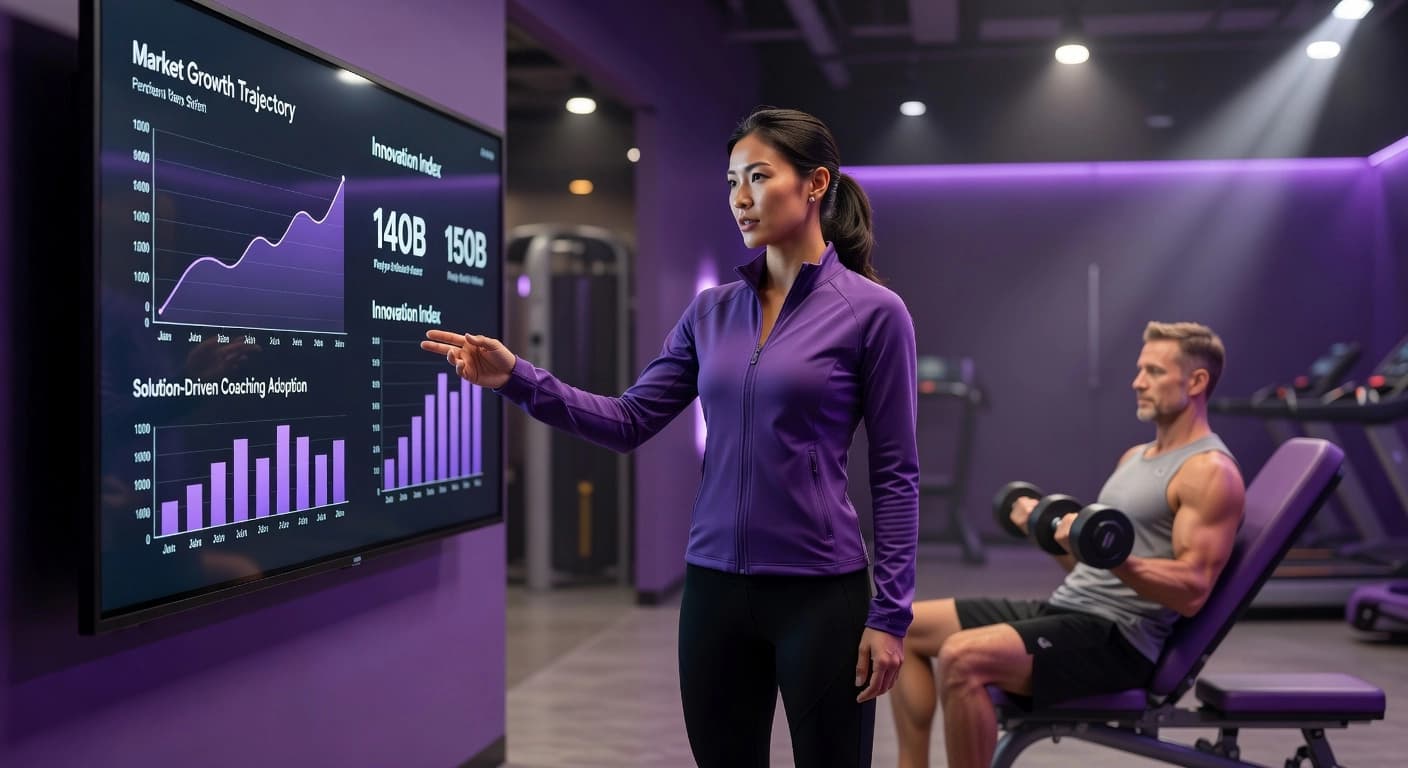
The personal fitness trainer market is exploding in 2026, reaching a global value of $15.6 billion, up from $13.9 billion in 2025, as reported by Future Market Insights. In the US, this segment is surging at a 10.5% CAGR through 2036, fueled by rising demand for personalized fitness training amid health-conscious consumers. This growth creates prime opportunities for intermediate trainers to scale operations beyond manual tracking.
Projections paint an even brighter picture, with the market expected to hit $43.3 billion by 2036 at a 12% CAGR, alongside approximately 370,000 US trainer jobs. Tech integration, including AI-driven personalization and data analytics, enables trainers to manage more clients efficiently without burnout. For instance, corporate wellness programs and active aging initiatives are driving demand, allowing savvy coaches to expand into niche markets like senior fitness.
Key trends underscore the shift: Wearables rank as the #1 fitness trend per ACSM's 2026 survey, with nearly 50% of US adults owning devices for real-time data. Mobile exercise apps boast 345 million users worldwide, enabling on-demand programming. Hybrid coaching models see nearly 50% adoption among trainers, blending in-person sessions with virtual delivery for broader reach, according to industry reports like those from MoneyInc.
To capitalize, trainers can tap the $638 million personal fitness training software market, growing at 7.6% CAGR. Step 1: Audit your setup; ditch spreadsheets for software that integrates wearables (prerequisite: basic tech familiarity; outcome: 40% retention boost). Step 2: Adopt hybrid models with app-based check-ins (tools: mobile platforms; expected: 30% client growth). Step 3: Leverage AI for custom plans (materials: data from 50% wearable owners; result: scaled business). Step 4: Track metrics weekly (outcome: sustainable revenue amid global outlook). This positions you for the boom.
Prerequisites for Scaling Your Fitness Training
Before scaling your fitness training business in this booming $15.6 billion market, complete these four essential prerequisites to identify bottlenecks and build a strong foundation.
Step 1: Assess Current Operations Start by auditing your workflows to pinpoint spreadsheet limitations that cap growth at 10-20 clients. Manual client tracking often involves scattered files for workouts, notes, and check-ins, leading to lost data and duplicated efforts. Progress monitoring relies on self-reported emails or texts, causing errors like overwritten updates and no clear trend visibility, which demotivates clients. Billing becomes chaotic with separate invoices and payment chases, consuming hours weekly. Expect to uncover 5-7 hours of admin per week; ditching spreadsheets for integrated tools can cut this by 60%, freeing time for 30+ clients and hybrid programs.
Step 2: Evaluate Tech Readiness Gauge your comfort with apps, wearables, and AI, as 64% of trainers now use AI for programming amid 2026 trends. With nearly 50% of US adults owning wearables (ACSM's #1 trend), ensure you can integrate data like HRV for personalized adjustments. Test basic app navigation for 345 million mobile exercise users. Actionable: Spend one week experimenting with free wearable exports; this boosts retention by 40% via data-driven plans.
Step 3: Define Business Goals Set SMART targets like doubling retention to 90% or achieving 50% revenue growth, benchmarked against the US personal trainer market's 10.5% CAGR. Track KPIs monthly, such as ARPU ($50-150) and churn under 10%. Use industry averages: retention at 75-80% stabilizes revenue five times cheaper than acquisition.
Step 4: Audit Client Base Segment clients for hybrid potential (nearly 50% trainer adoption) versus in-person, prioritizing niches like active aging (ACSM #2 trend) for boomers focused on balance and recovery. Categorize 40% for comprehensive support; test hybrid pilots. Outcome: Unlock scalable models blending live and async delivery.
Mastering these positions you for exponential growth.
Step 1: Launch Hybrid Fitness Training Models
To launch hybrid fitness training models effectively, begin by structuring your fitness training offerings to combine in-person sessions with virtual components, a strategy adopted by nearly 50% of trainers according to industry reports. This approach expands accessibility for clients facing geographic or scheduling constraints while diversifying revenue through tiered packages, such as basic app access paired with occasional gym visits. For instance, offer one weekly in-person session supplemented by app-delivered workouts and live virtual classes, enabling you to serve local and remote clients simultaneously. Prerequisites include auditing your current client base for hybrid suitability and selecting a robust app like LVLUP-App.com to ditch spreadsheets for seamless program delivery. Expected outcomes feature increased client lifetime value and scalability without burnout.
1. Blend in-person and virtual sessions. Start by mapping client needs: allocate 50-70% of programming to virtual elements like on-demand videos and progress trackers, reserving in-person for hands-on assessments. Integrate wearable data for personalized adjustments, boosting engagement as clients track metrics in real-time. This model increases revenue streams via upsells, such as group virtual challenges at $49 per month. Actionable tip: Pilot with 10 existing clients, transitioning them over two weeks while monitoring feedback. Industry data shows this hybrid blend enhances accessibility, with trainers reporting higher retention from flexible options.
2. Onboard clients to app-based check-ins. During initial consultations, demonstrate LVLUP-App.com features like daily forms for sleep, nutrition, and mood logs, setting clear expectations for hybrid participation. Automate reminders via SMS and push notifications to slash no-shows by 30%, as clients share progress photos and videos effortlessly. Provide a quick-start guide with video tutorials to ensure 90% adoption within week one. Materials needed: Client welcome packets and app access codes. Outcomes include stronger accountability and real-time insights for coaching tweaks.
3. Train staff or solo operations on dual delivery. Develop standardized protocols using video exercise libraries within your app, covering 500+ movements for home and gym use. Conduct role-playing sessions to align cues across formats, then test with mock virtual classes. For solo trainers, leverage pre-built templates to maintain consistency without extra hires. Track training via app quizzes for certification. This ensures brand uniformity, vital for intermediate teams scaling fitness training.
4. Track hybrid ROI. Use app dashboards to monitor key metrics: check-in rates above 85%, workout completion streaks, and churn below 10%. Calculate ROI with the formula (revenue gains from upsells minus tech costs) divided by costs, targeting 40% retention uplift from integrated tech like AI insights. Review monthly reports to refine offerings. Expected results: 20-30% revenue growth within six months, positioning your business for the $15.6 billion fitness training market surge.
This foundation sets the stage for further scaling steps.
Integrate Wearables for Personalized Insights
To integrate wearables into your fitness training for personalized insights, follow these four steps. This approach leverages the top ACSM fitness trend for 2026, with 32% of trainers already using wearable data for real-time adjustments, as nearly 50% of U.S. adults own devices like Fitbit or Apple Watch.
Step 1: Connect client devices for seamless data flow. Start by guiding clients to link their Fitbit, Apple Watch, or similar wearables to your coaching platform via Apple Health, Google Fit, or direct APIs. Prerequisites include client device setup and app permissions. Expected outcome: automatic syncing of live metrics like heart rate, allowing on-the-fly workout tweaks, such as reducing intensity during high-stress days. This mirrors ACSM's emphasis on real-time physiological data for safer, optimized sessions (ACSM top fitness trends).
Step 2: Analyze key metrics like HRV and steps. Dive into heart rate variability (HRV) for recovery insights and daily steps for activity baselines. Use trends to tailor workouts, personalizing loads to boost adherence by 40%, per recent studies on wearable interventions. Actionable tip: Set alerts for low HRV to deload, increasing client results and retention.
Step 3: Educate on privacy and syncing. Discuss selective data sharing, GDPR compliance, and opt-outs to build trust. Hold a quick session reviewing app settings, fostering long-term retention through transparency.
Step 4: Export to platforms for visuals. Pull data into your coaching software for charts, reports, and progress tracking, ditching spreadsheets. Generate weekly HRV graphs to showcase gains, enhancing client engagement.
This data-driven strategy scales your fitness training business efficiently.
Step 2: Leverage AI in Fitness Training Programs
To leverage AI in your fitness training programs, follow these four actionable steps. This builds on hybrid models and wearable integration by automating personalization, saving time, and boosting retention in the $15.6 billion personal fitness trainer market. Prerequisites include access to client data from wearables or apps, a basic AI platform (ditch spreadsheets with tools like those at LVLUP-App.com), and 5-10 clients for testing. Expected outcomes: 50% less planning time, 40% higher retention, and alignment with 10.5% market CAGR.
1. Adopt AI tools for workout generation. Start by selecting an AI platform that generates custom workouts and nutrition plans based on client goals, equipment, injuries, and preferences. Input client profiles to produce periodized 4-week programs with exercises, sets, reps, and meal plans including recipes and grocery lists, all in under a minute. Industry reports show 64% of trainers now use AI for this, with 52% focusing on programming and nutrition. Actionable tip: Review outputs for safety, then assign to clients via your app. Example: For a busy executive, AI creates a 30-minute home HIIT plan with macro-balanced meals, increasing adherence by personalizing instantly.
2. Automate progressions based on client data. Connect wearables and session logs to AI for real-time adjustments in volume, intensity, and exercises. Analyze recovery scores, heart rate variability, and feedback weekly to evolve programs dynamically. This cuts manual planning by 50%, freeing 5-10 hours monthly for client acquisition. Over 70% of trainers report handling 30% more clients without burnout. Test with one group first; expect faster progress and higher satisfaction.
3. Incorporate predictive analytics for adherence risks. Use AI to scan attendance, engagement, and biometrics for churn signals like missed sessions. Flag low-risk clients for nudges or tweaks, boosting retention 40% via early interventions. Platforms classify risks and suggest actions, improving adherence 71%. Monitor weekly; intervene with motivational calls.
4. Test AI outputs with A/B client groups. Divide clients into AI-generated vs. human-refined groups, tracking adherence, progress, and NPS over 4 weeks. Refine based on results to align with 10.5% market growth. Iterate quarterly for optimal personalization.
Implement now to scale your fitness training business efficiently. (292 words)
Step 3: Migrate to Fitness Training Software
To migrate to fitness training software effectively, begin by evaluating options that eliminate spreadsheets, streamline client management, and support scalable growth. This step builds on your hybrid models, AI integration, and wearable data by centralizing operations into a single platform. With the global personal fitness training software market at $638 million in 2026 and growing at 7.6% CAGR, the right tool delivers 2-3x efficiency gains, freeing 5-7 hours weekly for client coaching.[1] Prerequisites include auditing your current spreadsheets (client lists, progress notes, payments) and listing must-haves like habit tracking and group features. Expected outcome: Manage 50+ clients chaos-free with unified dashboards and automated workflows.
1. Compare Top Options for Spreadsheet-Free Management
Prioritize platforms excelling in unlimited client profiles, habit tracking (e.g., water intake, sleep logs), and integrated payments. LVLUP shines for solopreneurs with zero-commission Stripe billing, branded apps, and custom check-ins that automate delivery. Trainerize offers robust AI communication and group programming, ideal for hybrid scaling.[3] Everfit emphasizes simplicity with forums and daily insights for high-volume 1:1 coaching.[2]
Feature
LVLUP
Trainerize
Everfit
Client Management
Unlimited dashboards, photo tracking
Comprehensive check-ins
Messaging, forums
Habit Tracking
Daily custom metrics
Routine progress
Motivation routines
Payments
0% fees, Stripe
Integrated billing
Basic scaling focus
Solopreneur Fit
Top automation
AI-strong
User-friendly
Select based on your 50-client goal; LVLUP minimizes workload for independents.
2. Seamless Data Migration: Step-by-Step
- Export spreadsheets to CSV (clients, workouts, payments). 2. Use LVLUP's import tool to map columns to unified dashboards, auto-filling progress and acquisition metrics. 3. Pilot with 10 clients, verifying no data loss. 4. Integrate wearables for real-time sync. Avoid 20-hour manual transfers; complete in 2 hours for version-controlled accuracy.
3. Activate Scaling Features
Enable group challenges (e.g., LVLUP's ready templates for retention boosts) and wearable sync (89% platforms compatible). Trainerize and Everfit add broad integrations like Fitbit. Outcome: Handle volume with analytics, no chaos.
4. Calculate ROI
Formula: (Hours saved x $100/hr rate) + 30% retention lift - monthly fee. Example: 10 hours/week = $4,000/month gain minus $50 fee. Peers see 50% admin cuts, 20% participation rise.[1] Start your free trial today for immediate wins.
Step 4: Target High-Growth Niches
To target high-growth niches in fitness training, build on your hybrid models, AI integrations, and software migration by focusing on underserved markets with explosive demand. This step positions your coaching business for scalable revenue in the $15.6 billion personal fitness trainer market. Follow these four actionable sub-steps, using LVLUP-App.com's tools for client tracking, custom programs, and payments to ditch spreadsheets entirely.
1. Develop Active Aging Programs
Capitalize on ACSM's #2 trend for 2026 by creating programs for seniors amid the aging population boom. With 73 million U.S. baby boomers reaching 65 by 2030, and the oldest turning 80 this year, demand surges as adults 65+ visit gyms more frequently than any other group. Design 12-week plans emphasizing resistance training (3 sets of 8-12 reps, 2-3x/week) to combat sarcopenia, balance exercises to reduce fall risk by 32-40%, and low-impact cardio for heart health. Use LVLUP's 1,000+ exercise library to build functional movements like squats and lunges. Prerequisites: Certify in senior fitness (e.g., ACSM guidelines). Expected outcome: Retain clients longer with hybrid virtual classes, targeting $10B+ senior market by 2030. ACSM 2026 Trends
2. Create GLP-1 Support Plans
Address the #3 ACSM trend by supporting users of GLP-1 medications like Ozempic, where up to 40% of weight loss is muscle. Tailor plans with strength training (planks, push-ups, 2-4x/week), 150 minutes moderate cardio, and 1.6-2.2g protein/kg bodyweight to preserve muscle and boost metabolism. Track progress via LVLUP apps integrated with wearables. Over 25 million Americans may use these drugs by 2030, with 60% of trainers already serving them. Outcome: Differentiate your fitness training with niche 12-week protocols, minimizing rebound gains.
3. Launch Corporate Wellness Hybrids
Bundle wearables (ACSM #1 trend) into B2B packages for the $17.61 billion U.S. corporate wellness market. Offer $50-100/employee/month plans with AI-personalized challenges, virtual classes, and biometric tracking for reduced burnout. Pitch to HR via demos showing 40% retention boosts. Use LVLUP for scalable delivery. Outcome: Recurring revenue from 78% of exercisers prioritizing mental health.
4. Market via Long-Tail SEO
Optimize for keywords like "online senior fitness training software" using LVLUP's branded apps. Create blogs and YouTube content targeting 1K-10K monthly searches. Track analytics for funnels. Outcome: High-intent leads converting 2-3x better than broad terms. Pew Boomers
These niches drive 12% CAGR growth through 2036.
Track Key Metrics for Fitness Training Success
To track key metrics for fitness training success, build on your hybrid models, AI integrations, and software migration by implementing a data-driven monitoring system. This step ensures you outperform the 10.5% US personal trainer market CAGR through precise benchmarking and adjustments. Prerequisites include access to fitness training software with analytics dashboards, like those at LVLUP-App.com, and baseline data from your first quarter post-migration. Expected outcomes: 40% retention uplift, NPS above 57, and revenue growth exceeding industry averages.
Step 1: Monitor retention (aim 40% uplift), client NPS, and revenue per trainer. Start by calculating retention as ((end-period clients minus new clients) divided by start-period clients) times 100, targeting a 40% uplift from the 66.4% industry benchmark via AI personalization and wearables. Survey clients quarterly for NPS, aiming above the median 57 to drive referrals and cut churn. Track revenue per trainer against $17,400 annual averages, linking it to session pricing and hybrid uptake. For example, each 5-point retention gain can boost profits 25-95%. Review weekly in your dashboard to flag drops early.
Step 2: Leverage software dashboards for session completion rates and wearable compliance. Integrate wearable data (steps, HRV) into LVLUP dashboards to monitor 85%+ completion rates, where compliance yields 20-40% higher adherence than manual tracking. Set alerts for under 80% rates, correlating with the 50% US adult wearable ownership trend.
Step 3: Conduct quarterly reviews with AI insights and hybrid data. Aggregate engagement metrics like app visits and in-person sessions; adjust programs using AI for recovery-based tweaks. This hybrid analysis, adopted by nearly 50% of trainers, prevents 50% early churn.
Step 4: Benchmark LVLUP performance against manual methods. Users report faster scaling with automated insights versus spreadsheets, enabling unlimited clients without workload spikes. Compare your metrics quarterly to validate growth.
This positions your fitness training business for sustained scaling.
Avoid Common Pitfalls in Scaling Fitness Training
Overlooking Tech Training
Many trainers scaling fitness training overlook structured onboarding for AI and wearables, leading to a 25% adoption drop-off as clients abandon tools due to poor guidance. With wearables topping ACSM's 2026 trends and nearly 50% of U.S. adults owning them, this pitfall wastes the 40% retention boost from data personalization. Invest in 2-hour sessions covering device setup, HRV for recovery tracking, and app integration for workouts. Schedule these via Zoom post-signup, using demos to validate accuracy and set goals. Clients trained this way show 70% higher engagement, per industry benchmarks on digital literacy gaps. This prevents disuse among beginners and older users.
Ignoring Data Silos
Fragmented data across spreadsheets causes errors and relapse during growth, undermining hybrid models from prior steps. Centralize everything on one platform like LVLUP to integrate programming, check-ins, payments, and wearables seamlessly. This eliminates manual entry, cutting admin by 25-50% and boosting efficiency 30%. Migrate client histories, habits, and metrics into unified dashboards for real-time insights. Trainers report 20-80% retention lifts without silos blocking scalability.
Neglecting Niches Early
Skipping niches like active aging (#2 ACSM trend) delays quick wins in a market with 73 million U.S. boomers by 2030. Start small with 5-10 client pilots using templated programs for balance and low-impact cardio. Track progress via integrated software for evidence-based tweaks, achieving 92% satisfaction as in EnhanceFitness studies. This builds testimonials fast.
Underestimating Hybrid Ops
Hybrid demands dedicated tweaks, yet underallocating time leads to 50% churn. Reserve 20% of weekly hours for virtual personalization, like app updates and wearable syncs. This meets 85% client digital expectations, extending retention by months in mobile app trends with 345 million users. Prioritize to sustain scaling.
Actionable Takeaways to Transform Your Business
To transform your fitness training business in the $15.6 billion market, act on these five immediate takeaways for scalable growth.
1. Implement hybrid models this month. Pilot hybrid fitness training with 5 clients, blending in-person sessions and app-based check-ins. Integrate wearables, owned by nearly 50% of US adults per ACSM's top 2026 trend, to track real-time data. Expect a 40% retention boost from personalized insights, as shown in software market reports. Monitor progress weekly to refine protocols.
2. Migrate to LVLUP within 30 days. Ditch spreadsheets for LVLUP's automated client management and scaling tools. This streamlines hybrid delivery, saving hours on admin. Clients gain seamless access to programs, boosting engagement.
3. Launch one niche program quarterly. Target active aging or corporate wellness using AI for hyper-personalized plans; 64% of trainers adopt AI per 2026 trends. Aim for 20% revenue uplift through premium pricing.
4. Review metrics bi-weekly. Analyze retention, revenue, and engagement; adjust to 2026 trends like wearable integration for sustained 10.5% CAGR growth.
5. Join the LVLUP community. Access free templates and peer strategies to accelerate implementation and results. (148 words)
Conclusion
Scaling your fitness training business in 2026 demands strategic action. Key takeaways include leveraging AI tools and virtual reality for personalized, high-volume training; building high-performing teams to handle growth; optimizing online marketing and data-driven pricing for global profitability; and fostering client loyalty through community platforms amid regulatory shifts.
This guide delivers a complete roadmap, transforming plateaus into exponential growth without compromising quality. You now hold the blueprint to thrive in the wellness revolution.
Take the first step today: Audit your current operations against these strategies, then implement one immediately, such as automating onboarding. The fitness industry is yours to conquer; start building your scalable powerhouse now and watch your vision become reality in 2026.